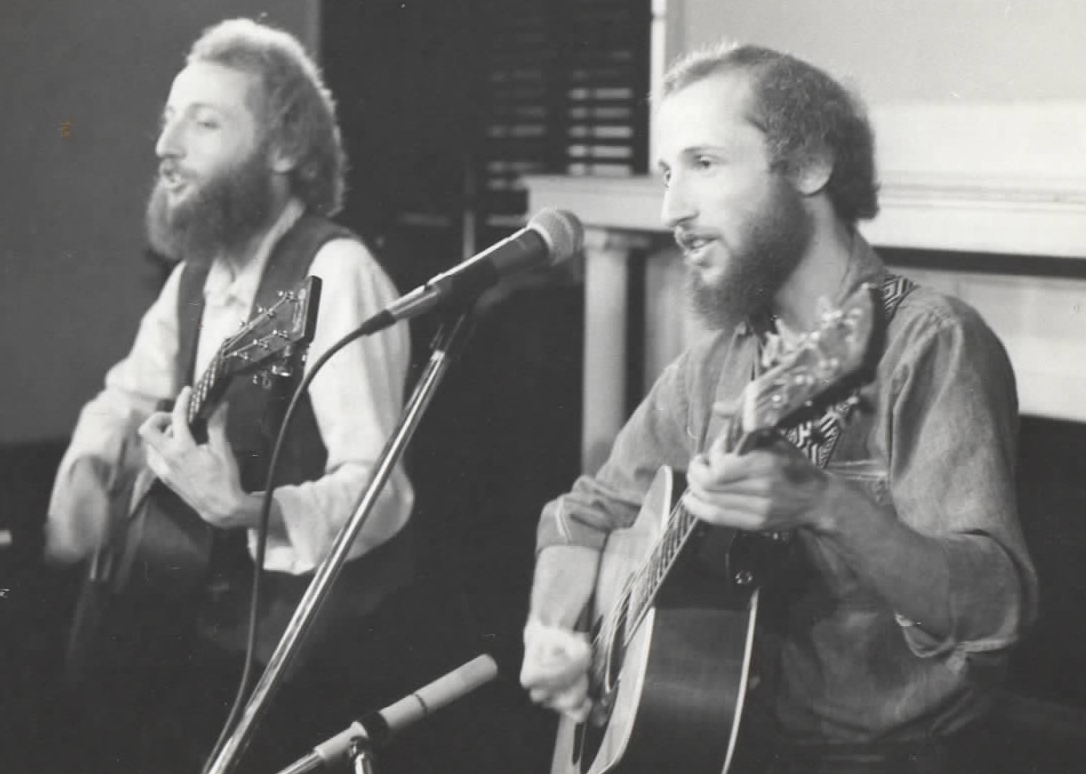
Our father did not approve—to put it mildly—of my brother’s and my choice of career. Multiple reasons for that, and no need to get into the nitty gritty here. Let’s just say that I can count on the fingers of one hand, and still have enough digits left to play an e minor chord, the number of our concerts he attended in thirty years—nor was he all that complimentary when he did come. But, when in 1989, we told our parents that we’d been invited to sing the national anthem before a baseball game at Detroit’s Tiger Stadium, our father seemed genuinely excited. He wanted to know how many people would be in the stands, how much money we’d make, (and didn’t even seem too disappointed when we said it’s an honorary function, not a paying one) and asked whether we’d sing alone or with organ accompaniment.
He knew the Star Spangled Banner. It was the first song he learned in English after we moved to the US in late 1959. He needed to know it for his job as a cantor in synagogues, where most social events began with the singing of our national anthem and the Hatikvah, the Israeli anthem. It was very difficult for him to memorize the English words by rote, and even more problematic to pronounce them correctly. He relied on my brother and me to help him, but his accent still mangled the lyrics pretty thoroughly. However, the sheer beauty and power of his voice lent the anthem great dignity and majesty, and there was no denying the reverence with which he sang. Over the years it remained the only song in English that the three of us all had in our repertoires.
So, in 1993, when our parents came to visit us in Michigan for the first time, Laz and I arranged to sing the anthem before a ball game during their stay.
On the drive to Tiger Stadium our father asked nervously if it would be okay for him to wear his hat at the game. As an Orthodox Jew, he always wore a hat or a yarmulke, but still seemed uneasy, the way he must have often felt in our native Hungary, about identifying himself so conspicuously as being Jewish. I reassured him that other than during the anthem it would be fine to wear his hat. I also told him that I’ve even seen people wearing yarmulkes at the ballpark and added that nothing he could possibly wear would look out of place at Tiger Stadium.
We parked on a side street, a few blocks from the stadium. Downtown Detroit was filled with sights my parents didn’t often see in the sleepy little town where they lived in Florida and may have even brought up for them some bad memories of post WWII Budapest. I could feel their nervousness about the litter-filled streets, the boarded-up houses, the panhandlers and street people, the scalpers aggressively offering to sell us tickets, and the vendors loudly hawking everything from peanuts to T-shirts.
We picked up the tickets held for us at the will-call window and headed into the tunnel underneath the stands of the stadium. It was an hour and a half before game time, but the dingy tunnel was already crowded and noisy with people buying food, baseball hats, pennants and miniature bats at the concession stands. Occasionally a small group of children came running through the crowd—probably spurred on by a rumor, or a glimpse, of a player signing autographs in another part of the stadium.
We spotted our section and turned, heading up the ramp, into the ballpark. That first glimpse of the field never failed to delight and refresh me. I glanced at my parents and saw them also visibly relax at the sight of the lush green of the outfield, the beautifully raked red clay of the infield, the bright white uniforms of the players. The ballpark was a small, emerald isle of beauty in the sea of gray despair that surrounded Tiger Stadium.
The ushers remembered Laz and me from our previous visits and welcomed us warmly. They led us to our row and wiped the dust off the blue stadium seats. My wife, Brenda, her parents, Bill and Norma, Laz's wife, Helen holding their baby Daniel, were all with us. We watched batting practice and tried to explain baseball to our parents.
In all his years of living in the U.S., our father never developed a taste for the game. “Nothing happens. Not like football.“ (He was referring to soccer, calling it by the name it is known all over the world, except in the U.S.) “Now that’s a real game.”
I told my parents that the pitcher tries to throw the ball in such a way that the batter can’t hit it. And that the batter tries to hit the ball where the fielders can’t catch it. My father looked bewildered and I remembered a story he told me about the first, and only time, his father, Shaya, came to see him play soccer. After the game, Shaya said, “What a stupid game! You were trying to kick the ball in the net and that guy wasn’t letting you. And then there was that idiot blowing a whistle all the time—what was he doing?”
I explained about the home run. Everyone else chimed in with the intricacies of the double play, the sacrifice fly, the intentional walk. I could see that my parents were not following any of this. I marveled at how hard it was to describe a game you’ve learned simply by watching and playing. Like explaining the colloquialisms of your mother tongue to a foreigner.
Laz and I left the baseball tutorial to go warm up our voices. We found a deserted corner under the stands and began to sing. My voice was tight and my breathing uneven. Laz also sounded tense. We always got more nervous for this two- minute appearance than for almost any concert. Our parents being there added still more tension. But, after about fifteen minutes of singing and walking around in the stadium tunnels, we finally began to loosen up.
We headed back to our seats. My father-in-law was regaling my father about seeing Denny McLain start a triple play in a game in 1968. And how his wife missed the whole thing because she had leaned over to wipe mustard off their nephew’s chin.
A few minutes before game time, Jim Brylewski from the Tigers marketing department came to our seats and accompanied us down from the stands, through the little gate near home plate, and out onto the field. We stood on the cinder track surrounding the diamond and made small talk with Jim, with a member of the grounds crew who set up the microphone for us, and with the man who was scheduled to throw out the ceremonial first pitch that day.
Every few minutes Laz nervously blew into the small pitch pipe we use to get our starting note and we hummed it to ourselves, trying to memorize it. Because of the crowd noise we feared we might not be able to hear it when it was time to start. (The Star Spangled Banner is notoriously difficult to sing. It has a big range, an octave and a fifth, so it’s crucial to not start it too high or too low.)
Gemini at Tiger Stadium
(Click to enlarge)
The managers and umpires finished their meeting at home plate and Jim gave us the signal. Carefully stepping over the chalk line that connects home plate and first base, we walked to the microphone near the pitcher’s mound. We faced the flag in deep center field, about 450 feet away, with our backs to the crowded part of the stadium. Laz leaned away from the microphone and sounded the pitch pipe one last time as the PA announcer said, “Ladies and gentlemen, boys and girls, please stand for the singing of our national anthem by Sandor and Laszlo Slomovits.” I knew from hundreds of hours of listening to games on the radio that up in the WJR booth Ernie Harwell and Paul Cary just finished announcing the lineups and were now telling the radio audience, "Let's go down to the field now for the singing of our national anthem."
A video image of us, taken from the back, was projected on the screen above the bleachers in center field. It was not a view I often had of myself. I noticed how bald we were—just like our dad. The words to the anthem were also projected line by line onto the screen. I looked away from them and focused on the flag instead. I worried that if the lines were flashed too fast or too slow, I'd get confused.
As on every previous visit to the stadium, I was struck by the sound of our voices, enormously amplified, echoing, coming from everywhere. The crowd began to roar as we held the last note on the word “brave” and nearly drowned out our ending. But the little cantorial cry in the voice that we’ve inherited from our father was clearly audible as we sang the word “home” in the last phrase.
We waved to the crowd and ran off the field. Our path took us near the visiting team’s dugout. Phil Garner, the mustachioed manager of the Milwaukee Brewers, had a big smile on his face and reached out to shake our hands. “Great job. Much better than what we usually hear.”
We made our way up to our seats a few rows behind home plate. Our father was visibly moved. He said with genuine warmth, “Was beautiful. It’s wonderful, people cheer like that for you.”
Here is a recording, made by Rob Martens, our longtime friend and musical colleague, of a WJR radio broadcast of us singing the anthem before a Detroit Tigers game. The recording also features the immortal voices of Paul Carey and Ernie Harwell. Go Tigers!
Our most steady gig in the Seventies was at Mr. Flood's Party, a small neighborhood bar in downtown Ann Arbor. Ned Duke, the owner was an avid antiques collector, and furnished his bar with original Tiffany lamps, antique mirrors, a barber pole, and a juke box that played records and also housed the bar’s PA system amplifiers. Ned also had a few plaster statues in Flood’s, including a slightly smaller than life-sized St. Francis of Assisi. Some patrons insisted, especially late at night, after a few beers, that the Saint looked like our triplet. There was a resemblance. Laz and I had similar beards and were balding in the same monastic pattern as St. Francis.
I had no experience with bars when we first started playing at Flood’s. I still recall my shock the first night when, during our first break, after I'd carefully gathered all my empty peanut shells into a neat pile on the table before me, a waitress came by and casually brushed them to the floor. Also, other than sipping a little Sabbath wine on Friday nights when I was growing up in my parents' home, I had relatively little experience with alcohol before we began playing bar gigs. I didn’t know a martini from a Martian. In college, although I experimented with drinking a few times at the omnipresent beer blasts, my sensitive stomach and thin build prevented me from over-indulging. Simply put, I got sick before I got happy, and well before I got sloshed. So, when we began playing at Flood's, I always asked for just a glass of water. Ned would sing out, "Fish bourbon coming up." However, I soon discovered that a few shots of good rum did not upset my stomach and yet very effectively anesthetized my occasionally sore throat. It took me a little longer to acknowledge that it had the same effect on my ears and spatial judgment. The tiny stage at Flood's was very high. By the end of some early evenings there, so was I. Teetering precariously near the edge of the stage, I sometimes played guitar chords one fret higher or lower than their correct position, all the while giving Laz accusing looks — certain that the discordant sounds were coming from him. After a few months at Flood's, I found other ways of coping with my sporadic sore throat and went back to “fish bourbon".
Even though I often felt as out of place at Flood’s as a priest at a frat party, it was there, and places like it, where we learned our craft. Beginning in 1974, until it closed in 1980, we played music from nine to two on many Tuesday nights in front of rowdy Flood's Party crowds. It was a great education. We learned how to respond to the changing moods of an audience, learned about pacing, and, eventually, learned how to put together a coherent set. When we began playing there, we were perfectly capable of playing a mournful Mississippi Delta Blues and follow it with the "Irish Washerwoman".
At Flood's we also learned how not to get distracted by anything that might happen in the audience during a show, a very valuable skill when we later started playing concerts for children. On one of our first nights at Flood’s, a couple of burly guys started throwing wild haymakers at each other. Laz and I immediately stopped playing. The bouncer, as he ran to restore the peace, yelled back over his shoulder, "Keep playing!" We started up again. After he'd tossed the combatants out on the street, he came back and forcefully hissed, "Never! Never! Never! You never stop playing if a fight breaks out — or for anything else!" We never stopped again.
Of all the things we learned at Flood's, one of the most necessary was to never surrender the stage, or our instruments, to strangers. Eventually, when asked, I'd resort to Eric Clapton's flip line, "Sorry, I never kiss on a first date." (It goes without saying that that was the only guitar-related subject in which I could hope to emulate Clapton.) However, until we learned to say “no” we did occasionally lend our guitars. I vividly recall the last time.
A man with disheveled, shoulder length black hair, wearing a faded T shirt, distended by his bulging belly, swaggered up to the stage and asked to play a few songs between our sets. The bouncer said he was OK, so we said sure. We sensed trouble right off the bat when he said that since he was such a big guy, he preferred Laz’s guitar, because it was bigger than mine. First, he strummed a few fresh scratches into Laz's acoustic Goya. Then he proceeded to sing and play ten minutes of the worst shouting blues I hope I ever have the misfortune of hearing. People began hurrying to the door like a ball game crowd leaving early when it’s obvious the home team can’t possibly win. Laz and I were forced to cut our break short so we wouldn't lose our entire audience. When the guy handed back Laz's now completely out of tune guitar he said, “Thanks, man. I haven't played in weeks. I had this real case of musical constipation. It just had to come out.” Laz muttered under his breath, “Yeah. It did sound like shit.”
We gradually recognized that the songs we were beginning to write and the music we really wanted to play did not work at Flood’s or at the other bars where we were playing. We had started getting invitations to folk festivals and to other coffeehouses like the Ark, we were beginning to tour out of state and we’d also started playing in schools. We gradually tapered off the bar gigs and mostly stopped by 1979. Laz said he knew it was time when he realized that we were starting all our bar shows with "Sloop John B" and noticed how much heartfelt emotion we were injecting into the chorus; "Let me go home. I wanna go home. This is the worst trip I’ve ever been on."
Laz
Nevertheless, when I think of the one place where we learned the most about performing, it was at Mr. Flood’s Party during those several hundred Tuesday nights where we played from 9pm to 2am.
After we’d been playing at Flood’s and other bars for a number of years but had also had a taste (at the Ark, at other area coffeehouses, and at folk festivals) of what it was like to play for an audience that just came to hear us play music, we decided to produce our own concert. We rented the Pendleton Room in the U of M Student Union for Sunday, January 22, 1978, and set the ticket price at $2, which is what the Ark charged. I don’t know how much the hall rental cost, but it couldn’t have been too much for us to consider it reasonable to recoup in ticket sales. We didn’t own a PA system and didn’t even consider renting one (see financial considerations above) but since we didn’t expect a lot of people, we didn’t think we’d need one. The Union provided 200 plastic folding chairs, which we were to set up, (and we did, though we worried that only the front few rows would be occupied) and a small wooden stage that (we learned during the concert) rocked side to side in response to our vigorous foot-stomping.
In the weeks before the concert date we sent out notices to our tiny fan base (San and I disagree whether these were hand-written postcards, or whether we had graduated by then to printed cards) hand-stapled posters to every pole and bulletin board we could find around town, and when the day of the concert came, I asked my wife, Helen, to help by taking tickets at the door. And then we waited.
A half hour before the 2pm start time, a trickle of people came up the stairs. This quickly became a steady stream, that turned into a flood. Fifteen minutes before the show, the Pendleton Room was more than three-quarters full — and I went around the corner and hid in a back hallway.
I don’t know if I knew the term “introvert” at the time, and whether it applied to me or not, but I knew this was the largest crowd we’d ever played for. And they had come just to hear us sing! Imagine that! I was terrified. Five minutes before showtime San found me in my hiding place, and with a radiant look on his face and in an awe-struck voice, he informed me that we had a full house. I replied, “I know. I’m not going out there.” San said, “What?” I repeated myself. He took hold of my forearm and started dragging me out of the hallway. When we got to the double doors of the Pendleton Room he let go of my arm and walked into the room — and to my amazement, (and since I was in full sight of the audience) I followed. And to my shock, the room erupted in applause. We stepped up onto the makeshift stage and started singing “Every Once in a While,” an a capella song that I’d written — and my terror vanished. For the rest of the concert, I was in a state bordering on bliss. I’ve been nervous many times before concerts since then, but it has never again occurred to me to hide and not want to come out.
However, let me get back to that term “introvert” for a moment. To this day, if you come to one of our concerts and have trouble telling us apart, San’s the one standing by the door to the hall, greeting everyone enthusiastically, while I’m in a back room somewhere, focusing on my breathing…
When we moved from Rochester, NY to Ann Arbor in July of 1973, we knew only a handful of things about the city. We knew about the University, Laz’s wife-to-be, Helen was planning to go to grad school here. We’d also heard that it was the “Dope Capital of the Midwest,” we’d heard of the huge annual Art Fairs, and we’d heard of the Ark Coffeehouse. The Ark already had a national reputation in folk circles by then. In those days Wednesday nights were open mike nights, or hoot nights as they were still called in the Seventies, at the Ark. For years, Laz and I showed up religiously nearly every week.
We went to our first Ark hoot just a few days after we moved to Ann Arbor. We didn't own a car, so we walked across town from our West Side apartment, lugging our electric guitars and a small amplifier. The Ark, then on Hill Street, was on the ground floor of a massive gray mansion near the University of Michigan campus. The house was set far back from the street and when we arrived a little before the nine o’clock start time, a few people were strumming guitars and banjos on the huge lawn and on the front porch. At the door we introduced ourselves to Linda Siglin, who along with her husband David managed the Ark, and told her we'd come to play. Musicians got in free. Everyone else paid a dollar to hear twenty to thirty performers play three songs each. (Tickets in those days were $2.50 for most regular Ark concerts.)
There was no stage. Performers stood or sat in front of the unused fireplace, in what had once been the living room of the huge house. Most of the audience, the front row barely a yard from the musicians, sat on cushions on the wooden floor. Two adjacent rooms, with wide doorways opening onto the main room, held chairs for the rest of the crowd.
Linda waved us toward the “green room,” across the hall from the living room. It was already crowded with musicians plucking guitars and banjos, a few sawing away at fiddles, and all nervously waiting to perform. Some of them nodded in greeting but most were too intent on their instruments, or their nerves, to make eye contact. We put our cases down, went back to the living room, and watched and listened from a doorway.
There were about thirty people in the audience. It seemed that most of them had come to see their friends perform because almost every singer was greeted with raucous enthusiasm by a few people and polite applause from everyone else. Over the course of the next hour the audience gradually grew, and the music got better, the performances more polished.
The musicians ranged from novices like us, who'd been playing guitar for two years and had hardly ever performed before an audience, to veterans of the local bar scene eager to try out some of their quieter songs in front of an audience that listened. Ark crowds were attentive, almost reverential. Perhaps this was due in part because at the Ark coffee was the strongest, and only, drink available.
Finishing the first set that night was Peter Madcat Ruth. Linda introduced him with obvious respect, telling the audience that Madcat regularly toured with Dave Brubeck and Sons. He received a warm and affectionate welcome as he picked his way through the seated crowd, carrying a colorful metal lunch box filled with harmonicas. Setting the lunch box on a stool before the fireplace, he selected a harp and launched into his first tune without saying a word. I was riveted. I’d never seen or heard anyone like him. His long blond hair streamed as he swayed to the music. He blew intricate rhythm patterns, bent notes impossibly far, and interweaved whoops and hollers into his playing. Eyes closed much of the time he accompanied his blues playing with vigorous foot stomping. His lyrics ranged from the hilarious to the profound, his melodies from softly meditative to driving. He was completely natural and at ease on stage, a total pro, with no egotistical showboating. The audience roared its appreciation during, and after, each of his three songs. Laz and I were too shy and intimidated by his talent to approach him that night but in the next few years we became good friends and Madcat has since joined us for many shows and has played on nearly all of our recordings.
After a twenty minute coffee and popcorn break, the music continued. Over the course of the next hour the audience gradually dwindled and there were few people left when Linda informed us that we’d be on next. She introduced us to the crowd warmly enough, saying that we were new in town and this was our first hoot. After the smattering of applause, there was an awkward silence while we set up our amplifier and plugged in our guitars. Then, a screeching howl of feedback when one of us, I no longer recall who, played a test note. Linda came rushing back to the stage and, with obvious irritation, suggested that maybe we had the amp turned up too high. We turned down and, meager confidence badly shaken, somehow struggled through three songs. I have no memory what the songs were, or how the crowd reacted. I remember slinking out as soon as we were done.
We never again brought our electric guitars to the Ark, but it was many months before Linda's first impression of us faded. She always put us on stage near the end of the evening. Hers was not a democratic, or first-come-first-served, or blind luck lottery system. She orchestrated the evenings so that the best performers were on stage when the crowd was largest. Several times we left without playing when we saw how late it was getting, how many musicians were still left, and how studiously Linda seemed to be avoiding us. But we came back, week after week, because it was our only chance to play in front of an audience. We learned so much from playing our three songs every week and watching the other musicians on hoot nights. We knew we’d finally arrived when one Wednesday night, months after we first started coming to the hoots, Linda invited us to finish the first set, and soon thereafter she and Dave booked us to play our first show at the Ark on March 14, 1974. We split the bill that Thursday night with the duo of Todd Kabza and John Bian, both excellent guitar players. We invited Ned Duke, the owner of Mr. Flood’s Party, to come hear us at that show, hoping he’d book us into his very popular downtown bar. More on that later.
Gemini at the Ark circa 1975
(Click to enlarge)
On October 10, 1974 we played our first solo show at the Ark. We’ve been very fortunate to have been able to play at least one show there every year since then. Many years we’ve headlined three or four shows and participated with other musicians in a number of others. For us, those shows have invariably been among the highlights of every year. When I think of the most influential people and venues that taught us, supported us and have helped us do what we’ve been able to do for the past fifty years, Dave and Linda Siglin, their daughter Anya, (who’s been doing the booking there for a number of years now) and the many folks who help run the Ark, they all are very near the top of the list.
Perhaps it was unsurprising and even inevitable that we would become musicians. After all, our dad made his living as a singer — as a Cantor in the synagogue — and from the time we were four years old until we left home to go off to college, we were his two-boy choir. Our mother, though profoundly tone deaf (for which our Dad teased her mercilessly), nevertheless contributed some impressive musical genes to us; her father was an excellent pianist, but more than mere facility in playing the instrument, he possessed the gift of being able to hear a melody once, at a concert or a theater, and being able to sit down at the piano and reproduce it from memory — and then improvise upon it.
Singing came to us as naturally as breathing. Our dad never gave us formal voice lessons, but we were immersed in singing the liturgy with him on a daily basis. His powerful, beautiful, well-trained voice was our atmosphere and constant model for how to sing.
Our parents started me on violin lessons and San on piano at age seven. This was not unusual in 1950s Budapest, Hungary, where we were born; learning to play an instrument was considered a natural part of a child’s education. However, if our parents expected child prodigies, they were quickly disappointed. Neither of us showed any particular promise, nor did we enjoy practicing. Nevertheless, the lessons continued well into our mid-teens when it became obvious that we did not have the heart to persist.
However, with singing it was a different story. Besides singing regularly with our dad, we were in Middle School choir (except for the year when our voices were changing, when we found it too embarrassing to let out the unpredictable squeaks and squawks that go with that age) and then in the New York State award-winning Kingston High School choir, occasionally soloing. Even more importantly, we had secretly begun to harbor dreams of being operatic tenors. We listened for countless hours to recordings of such early 20th century greats as Enrico Caruso and Beniamino Gigli, as well as contemporary (at the time) Metropolitan Opera stars Franco Corelli, Jan Peerce and Richard Tucker. We learned tenor arias from our favorite Puccini operas — and with the delusional confidence of youth, we were not discouraged by the fact that we couldn’t reach any of the high notes in those arias.
None of our friends were into opera (or liturgical music for that matter) but several were pretty good guitar players who sang the folk songs of Pete Seeger, Bob Dylan, Peter, Paul and Mary, Joan Baez, and others. While we were not quite as interested in this music as in opera, we did get caught up in the folk boom of the 1960s. One of our friends gave us Peter, Paul and Mary’s double album, “Live at Carnegie Hall” and we literally wore it out, while memorizing some of the songs and parts of Paul Stookey’s monologue. Our guitar-playing friends convinced us to try learning to play — it seemed like everyone was playing guitar and singing protest songs and love songs. They came with us to the one music store in Kingston to help us pick one out — but so did our dad because he was going to pay for it. He found the guitar our friends suggested to be much too expensive and bought us one that we found nearly unplayable — the strings were so far off the board that you needed gorilla hands to make a chord without buzzing the strings.
This was second semester of our senior year in high school, and we quickly gave up on learning guitar, and didn’t even bring it with us when we went off to college.
College. University of Rochester in upstate NY. Our parents had different dreams for us than becoming opera singers. San was to become an engineer and I a doctor. I lasted one semester in premed; San managed three in engineering. I graduated with a degree in English, San with one in History, neither of us with any plans on how to make a living — but with a new dream that had formed in the last couple years of college. We would become the next Beatles!
The fact that neither of us played guitar, had never written a song, and were already starting to lose our hair, were just a few of the reasons why this idea was as silly (I’m being generous) as it sounds now. But it was true that during those college years something had changed about our relationship to music. As one of San’s roommates pointed out, “The only time I see you happy is when you’re singing.” What had been a simple, natural part of our lives while growing up, had become a passion. We had realized we were not opera singers — our voice teacher at the Eastman School of Music, where we got to take weekly lessons, was very kind in pointing out that there are many kinds of music, and our voices were not suited to opera — but what was the music that was right for us?
Second semester senior year of college, I brought back from home the guitar untouched in the previous four years and found that the neck had warped just right to make the guitar playable — at least at the first few frets. I learned three chords and started playing them over and over, humming melodies all the while. By graduation time, I knew nearly a dozen chords and had started to figure out how to play melodies. San got his own guitar and started learning, and we thought we’d soon be ready for stardom.
In the meantime, there was the small matter of paying the rent and other necessities. A week after graduating we went looking for work. We showed up early that Monday morning at Manpower to see what we could find. We were put on a construction crew and assigned a stretch of concrete to break up with a jackhammer. I remember wondering who was going to win the wrestling match —me or the deafening tool!
Another day we were on a crew pouring cement for a sidewalk around the side of a house. This time I found myself wrestling with a wheelbarrow full of wet cement that was supposed to make its way around to the back of the house. Curving past the front door, the wheelbarrow decided it had had enough of its heavy, unbalanced load, and dumped its contents into the flower garden in the front yard.
Eventually, we each got steady work. San parked cars in a city surface lot. (He can still slam a car into a space hardly bigger than the car in one high speed maneuver.) His flooring-it-in-reverse, tire-squealing exploits became lunch-time entertainment for office workers in the surrounding buildings. Meanwhile, I worked a factory job assembling small transformers. When the boss wasn’t looking, I created mini sculptures from the solder dripping down the sides of the pot.
But all the while, every night and every weekend, and at other every spare moment, we were playing guitar, learning songs, and even starting to write our own. At first, we were still thinking Beatles / rock ‘n roll (I had even switched over to playing a Lake Placid Blue Stratocaster!) but little by little we started feeling our way to the music that felt right for us. As the months turned into that first year after college, we found ourselves starting to recognize this mysterious energy called “making music” that had entered our lives. We saw that it had actually started to shape how we identified ourselves, and how it was beginning to flower and grow.
It’s not just tonight. Every
night a new year begins
tomorrow. If we don’t have
the right to ask, right
now, for the highest
that we want, who does?
What if we were to set free
our deepest purpose, our cause
for being, our most heartfelt goal,
like a constant current coursing
through our lives? What if we
were to stand with a tray
in our hands ready to catch sight
of a gleam? What if with each
thought, word, and deed we allowed
the power of our intention, for all
tomorrows, to dip into all that once
was, and is now? What if, again
and again, we poured ourselves this
fresh moment in which to find gold?
Sometimes things can prove meaningful and significant to our lives, even though, on the surface, we may have no obvious connection to them, no reason to feel in personal relationship with them.
On June 20th, this year’s official celebration date of Juneteenth, the Federal Holiday commemorating the emancipation of enslaved African Americans, I was listening to a report on NPR’s Here and Now, when a familiar place name caught my attention. The report was about a recent discovery of court documents filed in 1828 by Sojourner Truth, the legendary abolitionist and women’s rights activist. The documents detailed her legal battle — which she won — to free her enslaved son.
The report told how a researcher, looking for something totally unrelated, had happened upon those documents filed 194 years ago in the Ulster County Courthouse in Kingston, New York. As soon as I heard the words “Ulster County Courthouse” I perked up, and a second later I heard the name of the city in which I had spent most of my teenage years. My parents, twin brother and I moved to Kingston in the spring of 1960, a few months after we arrived as immigrants in America. Three years earlier, we had left our native Hungary in the wake of the 1956 Revolution. My parents, both Holocaust survivors, wanted to give my brother and me lives without fear and oppression. To them, the Soviet Union’s brutal suppression of the Hungarian Revolution looked frighteningly similar to what they had endured during the Holocaust. Their intention was to move our family to the United States, but immigration quotas prevented that, so we lived in Israel for three years until we could move to America.
The reason a bell rang for me when I heard “Ulster County Courthouse” is because that was the place where, six years after we moved to this country, our family became naturalized American citizens.
A few minutes into the radio report, the interviewer introduced Dr. Nell Irvin Painter, historian, and author of a biography of Sojourner Truth, and asked her what it felt like to enter the Courthouse. Dr. Painter responded how dramatic and moving it was for her to walk up the same steps Sojourner Truth had walked, and to view those documents and the incredible initiative and bravery they represented.
I was almost 17 years old when I walked up those same steps with my family, and after the naturalization ceremony, walked back down them holding our citizenship papers. Even then, as a teenager, I knew it was an important moment, but it took me many years to more fully realize what a life-changing gift and opportunity I had been given that day — and my appreciation and gratitude for what was legally formalized in that Courthouse has only grown over the years.
Of course, for an African-American person, and especially for a woman, walking up those steps and seeing the X with which Sojourner Truth signed that document, would have far more personal significance and a feeling of ancestral connection than it would for me. Nevertheless, when I heard this story and realized I had walked up those same steps with my family for a legal ceremony that gave us freedoms and a promise that we would never have had in our native Hungary, something in me connected to Sojourner Truth and to all that she stood for. I felt inspired by her indomitable courage, and a heightened gratitude to her and to everyone who has contributed to and is continuing to work for “liberty and justice for all.”
Like all of us who are old enough to remember it, I know exactly where I was when I first heard about the attacks of 9/11. I was with my mother in her hospital room in Ft. Lauderdale, Florida that morning. She’d had a cancerous kidney removed the day before. I saw the news as I passed a TV screen on my way to get her some coffee. Thinking back now I’m shocked by the swift passage of time, and simultaneously by how long ago and far away those days seem now.
A couple of months after the events of 9/11 I wrote lyrics for a song about one small, hopeful, uplifting aspect of that tragedy. Every fact in the lyric is true. The melody that I first came up with did not please me and, besides, I could never manage to get through the song without getting choked up, so I didn’t ever try singing it in public. Recently I found another melody for the lyrics. I think it’s better. My friend and fabulous musician, Brian Brill, added this wonderful arrangement, and Brenda and Emily made it into a video:
She would have been 70 today. I met her almost exactly 50 years ago, in December of 1970.
The other day, reflecting on Helen’s upcoming birthday, I told our son, “You wouldn’t be here if she hadn’t been born 70 years ago.” I kept reflecting to myself how he also wouldn’t be the wonderful person he is if she hadn’t lavished boundless love and care on every aspect of his being for nearly 20 years. And, of course, I thought again what I’ve thought countless times before — how the boundless love and care she lavished on me was nothing less than my life’s support for 42 years, and has continued in subtle form these past 8.
And there are many, many others whose lives she touched in small or profound ways, who still treasure her expressions of kindness and her gifts of encouragement and wisdom.
On behalf of all of us, thank you again, dear Helen. And Happy Birthday!
On this day, eight years ago, my dear wife Helen left this world of the living.
The number 8, turned on its side, is the mathematical symbol for infinity.
A symbol — something that stands for something else — because infinity, eternity — in time or space — are concepts the mind can’t really conceive of. Like we can’t conceive of “gone forever” and yet have to accept it.
The number 8, like two circles stacked on one another — perhaps the world before we’re born and the world after we die — eternity, infinity — and that tiny point where they meet, where we live in this world.
There is also something of the 8 in a mobius strip, but my knowledge of science is too limited to do more than just point at that symbol.
Somewhere on the internet I found this (and lost it, and can’t find it again, so I can’t give you the source.) “In 108, the individual numbers 1, 0, and 8 represent one thing, nothing, and everything (infinity). Therefore, 108 represents the ultimate reality of the universe as being (seemingly paradoxically) simultaneously One, emptiness, and infinite.”
Once, when I was telling Helen about feeling I was just going around in circles in some aspects of my life, she told me about another way to look at what was happening. “What if you’re not going around in the same circle, but moving upwards in a spiral? What if each time you see this in yourself, you’re perceiving and understanding it from a higher perspective?” She helped me so many times with her wisdom and ever-positive outlook.
In music, the eighth note, the octave, is the note where the scale culminates, and simultaneously begins again.
And, of course, it’s purely coincidental that the eight letter of the alphabet is H — for Helen.
I can’t tell you why I find these symbols, these coincidences and synchronicities significant and moving but I do.
Dear Helen,
The mortgage got paid off last month. (Good timing, considering that I am essentially unemployed because of the pandemic.) You were the one who found the house, set it up as our household, enhanced it in so many ways, gave birth to our son in it, and left it for him and me as a place of creativity and shelter. When we bought the house 30 years ago, and I was 42 years old, I wondered if I’d be alive now to see it paid off. And here I am — and you are not.
And yet…
The Earth is mostly a closed system — most of all the water that was here eons ago is still here. So is most of the air, and so is all the earth itself, except for the things we’ve sent into space. All the molecules of all the beings that have ever lived on earth are still here.
Some atoms of the air you breathed may still be in the house, some of your skin cells might still be in one or more of the rooms.
The trees you loved and tended in the yard are still here.
The herbs and perennials you planted and cared for have come back every spring.
People still remember you, especially your kindness.
The books you edited continue to sell, and people write back with thank yous.
And of course, you are with me through the intangibles, the feelings, the memories, the dreams…
I go for a walk on a street
I haven’t walked
in a long time
and I find myself
thinking of you.
Did you walk it
with me
back then?
Or is it just
that now
you are
with me
wherever I go?
And you are with our son, Daniel. He has his struggles like we all do, but he’s also an amazing person with incredible skills and impeccable integrity. He’s also been a tremendous help to me, especially with technological needs, in retooling my concert presentations from live to virtual shows and recordings.
One thing Daniel and I did today to mark the anniversary is to look at photo albums — and we came across two pictures we hadn’t seen in a while. You were so beautiful, whether joyful or pensive.
Today, on the anniversary of your death, Daniel and I also did something that was quintessentially in your style. The sage in your herb garden has been especially productive the last few years and Daniel has gotten into drying it and using it for cooking, but also to make smudge sticks — to give away because we really don’t use them — he just didn’t want to get rid of the excess sage.
But there was still much too much dried sage, so today we decided to make a little fire pit in the back yard and burn all the dried sage we had not found any other use for — it was just getting dusty being moved back and forth between the counter and the table.
We got everything ready, and as we started to burn the sage (which doesn’t catch fire easily, perhaps that’s why it smolders and smokes so slowly in a smudge stick) it started to rain! You loved being in nature and never seemed to mind (even reveled in!) things like getting wet or muddy. You also edited a book called “Friendship with the Elements” (about earth, air, fire, water) — and here we were, Daniel and I, having made a fire on a sandy patch of earth, a fire which was kept alive by the air, as it consumed this ritual offering of a product of the earth, while making a fragrant smoke — and then here came the rain! We stayed by the fire as it slowly died down from the combination of having consumed the sage and being rained on — and as we stood there getting wet in the rain, we laughed, saying this is exactly how you would have concluded this little ceremony, enjoying all the elements having come together — and laughing!
The long awaited, eagerly anticipated film of Hamilton will drop tomorrow. My family and I will watch it—and then will likely watch it many, many more times. We saw the musical on Broadway in May of 2016, and it made a huge impression on all of us. The power of that experience has not faded, in some ways it has actually intensified, because our recollections of the show also bring back memories of where we were as a people and as a nation, and who our president was four years ago. Today it’s hard for me to recognize the country in which we are living as being the same one we lived in four years ago.
Four years ago, we also managed to see the 2016 Broadway revival of Fiddler on the Roof — in the same week we saw Hamilton. Fiddler made an enormous impression on me as well, partly because it enlivened my memories of seeing it on Broadway as a teenager fifty years ago, but also because the themes of the two shows echoed, reinforced and amplified each other.
I wrote a piece about my experience with the two musicals a few months after we saw them in 2016, and I ended it with a line from Hamilton; “Look around, look around at how lucky we are to be alive right now!” I felt that way about my life then, and even about the state of the world. No, I was not unaware of the enormous threat of climate change, I was not oblivious to the racism that suffuses nearly every aspect of our nation, (although I’ve lately been forced to see that it’s even more pervasive than I knew), and I was not unmindful of the myriad enormous challenges our country and world faced. Still, I felt we were headed in the right direction—albeit way too slowly—on many of those issues.
When I read that same line today, “Look around, look around at how lucky we are to be alive right now!” it sounds like a cruel, sarcastic joke. Trump’s entire tenure, especially his and his cohort’s insults and assaults on the poor, on people of color, on the LGBTQ community, on immigrants and refugees, on the environment, on much of what is good and decent in our country, as well as his spectacularly feeble and feeble-minded response to the pandemic, render that quote a gut punch line. And I’d be lying if I claimed never to feel hopeless, thoroughly disheartened, as well as enraged, by much of what surrounds us now. Not infrequently these days I find myself thinking of the “blessing” from Fiddler. “May God bless and keep the Tsar… far away from us!”
But, despite all of that, and more, and with full awareness that I might sound like a naïve Pollyanna, I am mostly still inclined to agree with the line from Hamilton. “Look around, look around at how lucky we are to be alive right now!” There are many reasons I feel that way. Here are just a few.
Yes, the virus is terrifying, but we are so much better equipped to respond to this pandemic than human beings were to the one in 1918, when a third of the world’s human population was infected and 50 million people died, including about 675,000 Americans. Today’s numbers are horrific, but pale next to those. (I know, I know…so far.)
A hundred years ago we had almost none of the amazing technological devices we have today that allow us to connect with each other, to work, to solve enormous problems, and still have the possibility of sheltering from the virus. (I know, I know… not available to far too many of us.)
In 2016 I, like many of us, had been lulled into thinking that we had, and were continuing to make, progress toward racial equality. The murders of George Floyd and of countless other unarmed people of color, and the protests that have followed, have shown how wrong we were, and also how fast and how much things can change—and how far we still have to go.
Yes, Broadway is dark today, but Hamilton, Fiddler, and other great works of art have not died; they are, and will be available, at a cost that is manageable for many; they still live and continue to inspire, to uplift, to tell our stories.
I hope you all get to see and enjoy Hamilton.
Here is the piece I wrote in 2016.
Since 1964, when Fiddler on the Roof opened on Broadway, it has been nearly impossible to grow up Jewish—or anything else—in America—or anywhere else—and not know the story outline and at least some of the songs from the iconic musical. And, unless you just emigrated here from Mars, you’ve undoubtedly heard of the current Broadway-and-beyond sensation, Hamilton. Earlier this year, in May, I was lucky enough to see both musicals on Broadway in the same week.
First of all, credit where credit is due. The only reason I got to see the shows is because my daughter Emily is a fan of musicals. (Do you recall that “fan” is short for “fanatic”? Enough said.) She discovered Hamilton soon after it opened on Broadway last year and started listening—non-stop—to the original cast recording. Last September she showed my wife a ten-minute clip she’d found online. When the clip ended, Brenda looked at her and said, “We have to go, right?” They didn’t have to work hard to convince me. “Why don’t we get tickets for Emily’s 22nd birthday, and all go together to see it next May?” The next day they went online and bought three tickets to Hamilton. (I’ll tell you later what we paid for them.)
Then in February Emily went to NYC with her theater class at EMU to see a number of shows on Broadway, including the new revival of Fiddler. Before she left, I regaled her with stories about how Fiddler was my first Broadway musical. It was in 1966, about two years after it opened. Herschel Bernardi was Tevye, having taken over the role a few months earlier from Zero Mostel who originated it. I told her how my aunt, who lived in Queens, managed to get my brother and me two standing room only tickets, how I was completely oblivious to the fact that I was standing for nearly three hours, totally mesmerized by what I was seeing. How, to this day I have a brilliantly vivid picture in my mind of Bernardi roaring, “There is no other hand!”
Emily saw the new Fiddler. Loved it. Raved about it. Insisted we had to see it. So, Brenda got two tickets to a Sunday matinee, while Emily got a ticket to She Loves Me, another Sheldon Harnick musical that was also revived on Broadway this year. The Fiddler revival is magnificent. I relished the restoration of my fifty-year-old memories, and I fell in love with a whole new set of marvelous ones. When Brenda and I finally left the theater, among the last ones to leave, both of us still wiping our eyes, she turned to me and said, “I thought about you, and how this might bring up some hard memories and feelings for you.” She wasn’t talking about the last time I saw Fiddler in 1966. She was referring to events long before that. In early 1957, when I was eight, my family left our native Hungary in the wake of the 1956 Hungarian Revolution. It was less than a decade after my parents married, and only twelve years after they both survived Nazi concentration camps. So yes, Fiddler’s family leaving their homeland touched off many memories and feelings for me.
Three days later we saw Hamilton. (Because we bought our tickets so early, before most of the world discovered Hamilton, we got them for $89 each. These days the show is sold out at least six months in advance and some people are paying four and even five figure prices for tickets.) Our seats were in the very, very last row of the Richard Rodgers Theatre. You cannot sit any farther from the stage in that theatre. It mattered not one bit. Oh sure, we couldn’t clearly see the actors’ facial expressions, but in retrospect that may have been a good thing. The show, even from where we were sitting, was so powerful, so moving, so stunningly beautiful, so overwhelming, that I’m not sure how we would have handled the additional impact of seeing the actors’ faces emoting the show’s many striking and tragic moments. Hamilton completely lived up to its unprecedented hype. I have never attended an artistic event that was as affecting, heartrending, soul stirring… I’ll run out of superlatives before I’m done trying to convey its effect on us. Months later, we still talk about it frequently. It’s the yardstick by which I will measure all artistic moments from here on out.
But I am not writing here to review Hamilton or Fiddler, or to crow about our good fortune in getting tickets at reasonable prices. Instead, I’d like to share with you, dear reader, some of my reflections about these two musicals.
If you follow Broadway minutia the way Emily does, you’ve probably read about the somewhat controversial frame that director, Bartlett Sher put around the current revival of Fiddler. But just in case you haven’t heard about it… Sher has Danny Burstein, who portrays Tevye (magnificently) start and end the show wearing a modern red parka, a clear reference to the millions of Syrian and other refugees fleeing the Middle East, Africa and other war zones, dangerous places, or debilitating poverty and lack of opportunity. Burstein’s weary stance on the stage at the beginning and end of the musical was a moving gesture that brought the fifty-year old musical powerfully and painfully into the present. Fiddler has never been only a Jewish story, but rather a universal, everyman, everywoman, every human story. And Hamilton is not really only about our founding fathers and mothers—though it does go a long way to help replace some of the sentimental, inaccurate, and untruthful Hallmark histories that we were taught in school. Fiddler on the Roof’s lyrics, melodies and characters—and the actors who portray them—could not look and sound more different than those of Hamilton. But on deeper levels, the two musicals are more alike than different.
While Fiddler portrays a moment in one of the more horrific chapters of European Jewry’s history, the era of the pogroms, it also foreshadows one of the more glorious chapters in Jewish history, the massive migration of European Jews to America, to the great benefit of both those Jews and our nation; and of Broadway, in particular. (It’s not inaccurate to say that Broadway as we know it would not be possible without the contributions of Jews.) Hamilton, meanwhile, is set in the pivotal moments surrounding the birth of our nation, but also takes place at that critical period when the institution of slavery was codified in our constitution and laws, legitimizing enormous human misery, and creating a system of gross injustice with which we are still struggling today. Alexander Hamilton did in fact argue strongly against slavery, and the musical’s lyrics touch on the issue a number of times. “We’ll never be free until we end slavery!” And, given its cast—primarily people of color—and its hip-hop language and music, it is impossible to see Hamilton and not be forcefully reminded of the subject.
Fiddler on the Roof is about the end, and near destruction, of a culture and its second chance at survival in America. Hamilton is about the creation of that America which—despite its history of brutal racism, numerous prejudices, xenophobia, and yes, even genocidal policies and actions—is also arguably our world’s primary embodiment of second chances for countless people, as it was for Alexander Hamilton.
This is why Fiddler and Hamilton struck particularly personal chords for me. Alexander Hamilton was able to emigrate from his impoverished birthplace in the Caribbean Islands, where the circumstances of his birth would have doomed him to a miserable and very limited life, while Tevye and his family were able to escape the murderous prejudices of their homeland. My family was incredibly fortunate to be able to come to America and make new lives that would never have been possible for us in Hungary.
The last lines of Hamilton are, “Who lives, who dies, / Who tells your story?” I will always be grateful to the creators of Fiddler and Hamilton, and all the people who have made it their life’s work to bring these shows to all of us, for telling these stories. As one of my favorite lines from Hamilton says, “Look around, look around at how lucky we are to be alive right now!”