My father always revered Jesse Owens and Joe Louis. Surprising heroes perhaps, for a man born and raised in far away Hungary. Not the heroes one might expect of a Jewish Cantor, whose work all his adult life had been the singing of liturgy in synagogues.
Yet, among the most vivid memories I have from my childhood in Hungary and Israel, through my teenage years in the United States, are the stories my father told of Jesse Owens and Joe Louis.
How one spring afternoon in 1935, coincidentally in Ann Arbor, Michigan, where I've lived since my early twenties, in the space of less than an hour, the magnificent Jesse Owens tied one world record and set five new ones. How one of those records, the long jump, lasted for more than twenty-five years; longer than any other record in modern track and field history. In his, and our, favorite story, my father told how Jesse Owens won four gold medals in the 1936 Berlin Olympics. How Owens' triumphs humiliated Hitler, who had predicted victory for, and had cheered on the German sprinters and jumpers. How Hitler hastily left the Olympic stadium after Owens' victory in the long jump, rather than stay to congratulate Owens. My father would explain, "Hitler didn't want to be seen in a photo with a Negro. He wouldn't shake Jesse Owens' hand."
My father also delighted in acting out the boxing dramas of Joe Louis. Many times, in our living room, back yard, or even occasionally before services in shul, he'd ball up his fists, get into a prize fighter's crouch and show us how the Brown Bomber landed the savage right to Max Schmeling's kidney that fractured two vertebrae in the unlucky challenger's back.
"Two minutes! Just two minutes and four seconds is all it took!" he would exclaim. "They say that a Texas millionaire was at ringside that night, wearing one of those big cowboy hats. When somebody accidentally knocked his hat off soon after the beginning of the fight, he bent down to get it. By the time he looked up, the fight was over." Saying this, my father would laugh till tears came to his eyes. Then he'd add dramatically, "Can you believe it? Hitler had even sent Schmeling a telegram before the fight. 'Congratulations to the new heavyweight champion of the world.'" Again he'd laugh. Again tears would fill his eyes.
My father was a gifted storyteller and the stories of great men were his favorite topic. He knew many stories. Some of them were of singers like him: of Moshe Koussevitzky, the legendary Cantor, Gigli, the great Italian operatic tenor. and Chaliapin, the famed Russian bass baritone. Others were about the teachings and sayings of the great Rabbis of history, and still others were of his childhood and adolescence in Hungary between the two World Wars.
Always, always though, he came back to the stories of Owens and Louis.
And, of his own father.
There are only two pictures left of my grandfather Shaya. In one he is a young man wearing his WW I Hungarian Army uniform. He is posing in profile, his rifle in his right hand, a long pickax in his left. On his back is a full knapsack, and binoculars hang from a strap around his neck. He was an advance scout. His assignment throughout the war was to climb mountains and lookout towers, occasionally behind enemy lines, and report on troop movements. His face, looking out of the old daguerreotype is calmly confident, almost defiant. A man aware of his powers.
When WW I ended, small bands of troops from the retreating Checkoslovakian Army, entered his city of Balassagyarmat and began looting homes. My grandfather stood by his front gate, rifle at the ready. "They are not coming in here," he said. And they didn't.
After the war, because of his Army service, Shaya was allowed a gun permit and carried a pistol in his travels as a peddler. When in the late Thirties the many restrictions against Jews began to be enforced, Shaya lost his permit and his gun. One day, traveling home from a successful selling trip he was attacked by two robbers. Wielding a loose plank from his cart, he knocked both men senseless.
When my father was about twelve years old, one Saturday morning he was walking home from synagogue services with a few of his friends. Grandfather Shaya and the other men were walking some distance behind them. A group of teenagers surrounded the boys, and began chanting, "dirty Jews, dirty Jews." When one of them yanked my father's payis, the customary long sideburns of religious Jews, and landed a blow to my father's head, Shaya came running and the young men fled. He caught two of them from behind and hit them so hard with a fist in each back that they fell face down on the ground.
In 1940, Shaya, despite being 53 years old, was ordered into the munkaszolg·lat, the work detail attached to the Hungarian Army into which many Jewish men were conscripted. Stationed far from home, he rarely saw his family. One week however, his unit camped only five kilometers from his home town of Balassagyarmat. That Friday, Shaya decided to walk home to spend the Sabbath with his family. He neglected to inform anyone that he was leaving. When he returned Sunday afternoon his commanding officer accused him of desertion. Shaya retorted, "I'm here. Besides," and at this point he stepped close to the officer and repeatedly tapped the man's chest with his index finger, "If you hadn't seen your wife and children in three months, and you were this close, what would you have done?" The matter was dropped.
Shaya was released from munkaszolg·lat when a lookout tower, like the ones he'd climbed more than twenty years before in WW I, now rotted from years of neglect, collapsed under him. He broke his right shoulder and several ribs and never quite recovered from his injuries.
When my brother and I were about sixteen years old, my mother told us one day that she was our father's second wife. That he'd lost his first wife and their three young children in the Holocaust.
This almost unbelievable news was barely comprehensible to me at first. And, it was somehow silently understood in our family that we would not talk about it with our father. After my mother's revelation that day, many years went by before I allowed myself to even think about these things, and years more before I braved talking about them with my father; years before I would understand the sadness I'd always sensed in my father even when I was still a little child, but whose cause I'd never before known; years before I knew why he kept to himself so much, why he rarely joined my mother and brother and me on family outings to parks or beaches, saying that he needed time to study for the next week's Torah reading. We all knew that was not true. He could almost recite the readings by heart after so many years of study and repetition. He didn't need to rehearse every Sunday afternoon, all afternoon.
The truth was, he wanted to be alone. It sometimes seemed to me that he wanted to be alone so much that he was not a part of our family. That day when my mother told us, twenty years after they were murdered, my father was still mourning his first family.
His frequent stories of Jesse Owens and Joe Louis gradually came to mean more to me. I began to see why the victories of Owens and Louis held such mythic power for him.
In June of 1938, when Joe Louis knocked out Max Schmeling, my father was living in Kunhegyes, a small town a hundred-twenty-five kilometers east of Budapest. He served as Rabbi, Cantor and school teacher for the Jewish families living in that community. Although he was happy in his life in Kunhegyes, he was well aware of the gathering horror of Hitler. After Krystalnacht in 1938 he had visible proof that Hitler's insane rantings could inspire very real violence. In 1942 that horror and violence pounded on his door. When war broke out, like his father Shaya, he was ordered into the munkaszolg·lat. He spent much of the rest of the war in work lagers in Poland. When he returned home to Kunhegyes in late 1944, my father discovered he had lost everything to the Nazis.
While he was away in the munkaszolg·lat, much of his family was taken to Auschwitz in cattle carts. There, besides numberless more distant relatives, he lost his father Shaya, his mother Rozsa, his only brother, three sisters, and, perhaps most excruciating of all, his wife, two sons and a daughter.
My father always believed that Shaya, had he not been recovering from the fall from the lookout tower, would have never been taken alive to Auschwitz. He was certain that Shaya would have taken to the grave with him a number of the Csendˆr, the hated Hungarian state police who rounded up Jews to transport to the Camps.
I used to have different fantasies, even more unrealistic. I dreamt that Shaya might have been able to save the whole family.
Jesse Owens and Joe Louis were exceptional men, worthy of my father's admiration. However, my father did not look up to them only for their athletic feats. He revered them because they did something he had not been able to do.
(We've sung the National Anthem before a Tiger baseball game every year since 1989. We got to do this after meeting the then-owner of the team, Tom Monaghan, on a radio program. We told him of our long-standing dream to sing the Star Spangled Banner before a Major League ball game, and a few months later we got our chance.This article first appeared in the Detroit Free Press on Sunday, July 29, 1990, just a few days after comedian-actress Roseanne Barr sang her famous shrieking rendition of the National Anthem before a San Diego Padres-Cincinnati Reds game.)
Last summer my twin brother, San, and I were invited to sing the National Anthem at Detroit's Tiger Stadium. On July 30th, just before the game between the Tigers and the Minnesota Twins, we walked out on the field, stood half way between home plate and the pitcher's mound, and faced the flag waving in the breeze out beyond center field.
I had known it would be an emotional moment, and so I'd prepared for it. Having been a professional singer for more than fifteen years, I'd learned that the first few times I sing a powerful song it will move me to tears and choke me up to where I can't continue. So a few weeks before we were to sing, I went to a game at the stadium, and as the singer that day began the anthem, I visualized myself in her place – and, of course, I got all choked up. When the tears started coming, I let them come. Over the next few weeks I kept singing the anthem at home, letting that huge feeling wash over me, until I could sing it without getting lost in it.
Nevertheless, no practice or visualization could prepare me for the energy that rose up when San and I actually stood on the field and started to sing "O say, can you see". Twenty four thousand people standing, singing with you, facing a red, white, and blue piece of fabric that has come to mean a way of life so precious to so many people – it was an incredible thrill! Thankfully, we managed to pour all that energy into the singing, and there were no tears.
Later, as we sat in the stands and watched the game, I thought back to my first memories of the "Star Spangled Banner", and of our coming to the United States.
*****
San and I were nearly eleven years old, and we were immigrating with our parents from Israel to America. Two and a half years earlier, we'd left our native Hungary in the wake of the 1956 Revolution. Our parents had dreamt of coming straight to America, but so did everyone else who was leaving Hungary at that time, and so the U. S. immigration quotas were quickly filled. Now, the dream was about to come true.
We'd been nearly two weeks crossing the Atlantic, and today, November 28, l959, our ship would dock in New York Harbor. Our parents were still eating breakfast down below, but San and I had gotten permission to go topside. Two sailors who had befriended us earlier in the trip, now bought us each a Ginger Ale and invited us out on the deck to catch the first glimpse of land. Neither San nor I had ever had a carbonated drink before; we were fascinated.
It was a cold, cloudy morning, and a thick fog hung in the air starting just a few feet above the waves. After our eyes had gotten used to it, we could make out a low, dark mass on the horizon. Gradually we began seeing the jutting skyscrapers of the New York skyline. And then, looming up out of the water, a great statue of a woman holding a torch. There had been nothing to prepare us for this sight; we'd never seen a picture of her, nor had we ever even heard of her.
When they saw the statue, the two sailors started grinning from ear to ear and thumping each other on the back. They kept pointing to it, trying to tell us something. Since we didn't speak English and they didn't know Hungarian, we'd been communicating with gestures all through the trip. It didn't matter in the slightest now that we didn't understand their words; the feelings came through loud and clear.
My mother joined us on the deck. A tough, proud lady who had survived the concentration camps of World war II, she stood there now with tears in her eyes. My father, an Orthodox Jew who always kept his head covered, took off his hat. San and I sipped our Ginger Ales, our first gift from this new land, and watched the statue grow as our ship drew closer to shore. It is still one of my most vivid memories – the Statue of Liberty coming into view through the fog, that very first time.
The first time I heard the "Star Spangled Banner" must have been a few weeks later. I don't remember, but undoubtedly it was played during homeroom at the Bronx elementary where we first attended school in this country. Very likely it was an instrumental version, played through the school PA system, complete with static and distortion, from a scratchy old album by the Army-Navy Military Band. If it was a choral version, I wouldn't have understood a word of it anyway, since I still didn't speak English. However, in the next few years, without ever trying, I learned the words and the tune in the same mysterious way that I learned to speak English, play a violin in tune, and catch a baseball.
A few years later, my father, a synagogue Cantor, started performing at social functions in some of the big resort hotels in the Catskills. These events always started with the "Hatikva", the Israeli National Anthem, and the "Star Spangled Banner", which my father didn't know. So San and I coached him on the pronounciation and meaning of the words. Dad was not a quick study – and it didn't help that we were teen-agers, with the lack of patience and respect that seems to go with that age. But I still remember how hard he worked on it. Over and over again, he twisted his tongue around unfamiliar words like "ramparts" and "perilous". Again and again he shook his head and struggled to make sense out of that convoluted hundred and fifty year old poetic syntax. And it wasn't just professional pride or fear of embarrassment that drove him; having survived the Holocaust and the Hungarian Revolution, he was incredibly grateful for the chance to live in this country. He'd be damned if he was going to mess up its National Anthem!
When he sang it in public for the first time, nobody would have mistaken him for a native speaker, but you just knew he understood and felt every single word as he was singing it. He sang it with the same fervor and beauty which he brought to the most sacred texts in the liturgy. As he sang I could almost see "the rockets' red glare, the bombs bursting in air" and the "broad stripes and bright stars" of the very same flag which so moved Francis Scott Key back in 1814.
In the spring of 1965, when we'd lived the requisite five years in the United States, my parents, San and I became naturalized citizens. The ceremony was held in a small courtroom of the City Hall in Kingston, NY. A color guard marched in and presented the flag. Then the Pledge of Allegiance was recited and we all joined in – "I pledge allegiance to the flag of the United States of America..." Twenty four new citizens – and what a rich melting-pot of accents!
Finally, a well-known local mezzo-soprano sang "The Star Spangled Banner". Afterwards, my father said, "She had a great voice, but they should have let one of us sing it. It means more to us. We would have sung it with more feeling." When we got home, the first thing he did was hang the flag we'd been given at the ceremony out on the front porch.
*****
And now here it is 25 years later, and the Tigers have invited us back to sing the Anthem again. After we accepted the invitation I knew I had to go to at least one more game before today – just to make sure there are not too many lumps in my throat when San and I face that Star Spangled Banner out beyond center field.
In more than quarter century of playing music for children and families, we've heard, and read, some great lines from our small fans. Here is a sampling.
On the subject of our twinship:
"How did you get to be twins?"
"Why are you twins?"
"How long have you been twins?"
"You guys are twins, right? That means you have the same mother right?"
"Where did you two meet?"
"You two look the same from the back."
And, perhaps my favorite. A little boy came up to us following a concert, and after scrutinizing us carefully for a minute, announced,
"I have a friend who looks like one of you." And then stood there for another minute trying to decide which one of us his friend resembled.
One more, this from an adult couple who told us, "You sang at the wedding of friends of ours and now they are expecting twins." Our reply?
"That's delightful! But we're not taking any credit or blame."
About our songs:
"I like all the music that you played. Of course I do. Who wouldn't?"
"I really liked your program. My favorite song was all the songs."
"Are some of these songs true?"
"My favorite was 'Puppy Love'. I have a dog. He's not a puppy though, but we got him as one. His name is Tyler."
"I liked the song 'Puppy Love' because I have two dogs. One is little and one is big."
"One of my favorite songs you sing is Deli. I noticed you left out the Ziggerman's or something like that, but it sounded just as good."
"You know that song, Oh Susannah? You didn't sing it right."
"You know that baseball song, 'Take me out to the ballgame'? Bob Uecker wrote that."
About our recordings:
"My teacher just got one of your tapes. Now she has them all. I don't blame her."
"As soon as I pay off my Cockatiel I will buy a few tapes of yours."
"You guys are cool dudes. Do you sell your records in Ann Arbor because my dad always goes there to get the kind of bread they sell... yuckkkk!"
"I play the piano and I'm ten years old. I'm going to buy a tape of yours. I hate rock but I love classical."
"When I first played your tape for my mom, she said, 'it's a nice change of pace from Mozart'. We used to listen to Mozart all the time but we listen to you now."
And this from a little boy who wanted to know how much our recordings cost, but said, "How much are your CDs worth?"
We get compliments:
"I hope when I grow up I can take my kids to go see you perform."
"I liked your show. I've seen you two times before. I liked you both times."
"Do you have another job? Or are you good enough that you do only this?"
"At least five or ten people in my class were singing along."
"Do you guys ever catch your breath?"
"I thought you guys were okay."
"Will you stop playing that music! Play heavy metal instead." (1st grader)
"Since I heard you sing I wanted an autograph so bad. So the main point I'm writing this letter for is to tell you I want one."
They get personal:
"Who does your hair?"
"Where do you shop?"
"How old were you when you were born?"
"The one I thought was the oldest was Sandor and I think you are 56 years old. No. I bet you are in the twenties, at least 24."
"I like your music. Do you like me? Are you married? Have you ever been married?"
Most of our school concerts are for elementary age kids. Occasionally though, we play at a middle school. Near the end of one of those concerts,
during the question and answer part, we noticed a group of eighth grade boys egging on one of their classmates. "Ask 'em. Ask 'em",
we could hear, even from the stage. Finally the boy raised his hand and we called on him. His question? "Do the instruments get
you any women?" After the laughter died down I replied that I did meet my wife when she came to one of our concerts. They looked
disappointed. That's clearly not what they had in mind.
Unsolicited personal information:
"I got two brothers and one mom and one dad and me."
"Do you have a dog? I have one. Do you have a pig? I don't."
"Do you get nervous when you perform in front of a huge crowd? I do."
"Do you have any kids? I have two brothers. I hate them."
The "from-the-mouth-of-babes" category:
A few years ago we sang the Anthem before a ball game in Tiger Stadium in May. At a school concert the day before the game with the Minnesota
Twins, I jokingly told our audience that I guaranteed a Tiger victory. After the concert a little boy came up to me and asked, "So you're sure the Tiger's
will win tomorrow?" I said, "Oh yes, I guarantee it." He shot back, "You better hope Kirby Puckett is on the disabled list."
And then there was the little girl who told me about her class having taken a recent tour of the local police station. She was most intrigued by the
locker room. She had asked the tour guide, "If you're policemen, how come there are locks on your lockers?"
And finally, one we're still trying to figure out: "Please come back. Take your time."
"You were here last year," the boy declared almost defiantly, looking up at my brother, daring him to deny it. Laz nodded agreeably. We play music for children and families and we had, to be perfectly accurate, played a concert at this school not one, but two years before, but there was something in this fourth grader's tone that seemed to say, "Let's not sweat the details, OK?"
"You're not very big," he continued. Again in that somewhat pugnacious tone. No argument there either. "I guess not," Laz agreed affably. The boy, his black high-top sneakers untied, T-shirt hanging down almost to his knees, hair tousled from outdoor recess, put his hands on his hips and delivered his final statement.
"You were bigger last year."
One of my earliest childhood memories is of being in the hospital, quarantined with scarlet fever, craning up at my parents who were waving from the other side of a window high above me. The window must have been at a standard height. It just seemed impossibly high from my three year old vantage point. Perhaps in the same way, to that little boy, Laz had loomed taller two years before.
Near the end of our concerts my brother and I often leave time for questions from the audience. In almost every concert somebody asks, "How old are you guys?" Although we eventually 'fess up to the truth, first we make a game out of it.
"How many people think we're over thirty. Raise your hands."
All hands shoot up.
"OK, how many people think we're over forty?"
A smaller, but still depressingly large group of hands go up.
"Over fifty?"
A still smaller group of hands go up uncertainly. I'm grateful for their hesitancy.
"Over sixty?"
Now they get it and start to giggle. Lots of hands shoot up.
"Older than eighty? "
Everybody's laughing now and all the hands are waving enthusistically in the air.
Then we say, with lowered voices, as dramatically as possible, "You're all still too... low."
Pointing to each other we say, "Between the two of us, we are..." and we name the figure, as of this writing, a hard-to-believe 102, that is the sum of our years.
Twenty seven years ago, when we started playing concerts, kids almost always guessed us to be younger than we were. These days they usually guess a lot closer to the truth. Recently at a concert, after we told everyone how old we were, a little girl said, "Wow, you're even older than my dad." At another recent concert a young mom, holding her wriggling two year old, said, "My parents used to take me to your shows. I grew up on your music."
"Wow!" was all I could manage. Has it really been that long? When I look in the mirror these days, I do see more lines and less hair, and what hair is left is greying. But my inner view of myself has not changed. Inside, I don't look, or feel older. Inside, I seem not to have changed since I was about twenty five, when I first started thinking of myself as grown up. My audiences remind me otherwise. "You were bigger last year. Wow, you're older than my dad. I grew up on your music."
And yet, because we play music for children, our audiences today look the same as they did twenty years ago. They haven't aged at all. And when I'm singing with them, I feel as if I haven't either.
I have a six year old daughter now. As with the more than quarter century of playing music, I'm astonished how fast those six years have gone; how much she has changed in that time, and, how little changed, it seems, I feel.
It is said, 'time flies when you're having fun.' When you're having fun, I think it also stands still.
My father in law, my daughter and I are flying a kite in Vets Park in Ann Arbor, a five minute walk from our house. It's early on a gorgeous Sunday morning. We have the park to ourselves. The baseball and softball games have not yet started.
The kite, a big purple diamond, is last year's Father's Day gift to me from my wife. Emily runs with it to get it started. I hold the spool and let it spin out. The kite climbs higher. She runs after it as it swoops and soars in graceful patterns in the sky.
My father-in-law looks at the kite and reminisces about going to the hardware store as a kid and asking, "Mister, could I have 5 cents worth of string?"
This was in Kentucky, in the early 1940's. My father-in-law was eleven or twelve years old.
"I was working by then, setting out tobacco slips for 25 cents an hour. In the spring, it's already very hot in Kentucky. I remember that. We made our kites out of thin, worn rags. The long crossbar we made of the dowels you used for poking the holes in the ground for the tobacco slips. The short crossbar was just a twig from a tree. We used a torn up T-shirt for the tail. It worked good."
Emily runs back and asks to hold the spool. I hand it to her, warning her to hold on tight because the kite is high in the sky and the wind has picked up. Bill continues, his memories spinning out, stretching back, like the kite climbing away from us.
Emily hands back the spool. The kite is pulling harder now and she wants to listen. Maybe someday, she will fly a kite with her own child, and tell her of Grandpa Bill. Maybe she will tell her of her own kite memories of this day. Or maybe, if I'm lucky, I'll be there too and the threads of memories will tug at me insistently – from as far away in the sky as the kite is now in the blue. And I'll be able to reel it all back in, for both of them, on that thin but strong-enough line.
Just west of Grand Rapids, Michigan, on I-96, there is a barn with a mural on its side. The painting faces the highway, and is only visible from the road. All the houses in the area are on the other side of the barn. I noticed it for the first time a few years ago while driving by on our way to a concert. I didn't catch all its details but the mural was a colorful, idyllic, pastoral scene complete with a silo. The artist had extended the image above the roof line of the barn by adding, and painting, a wooden facade for the cap of the silo.
The road conditions were bad that day and I was becoming concerned we'd be late. A gusty wind was blowing the thickly falling snow across the highway. I didn't dare take my eyes off the road for long because it was a bit slippery and I was having a hard time seeing my way through the swirling curtain of snow.
Still, even that brief glimpse of the barn was uplifting – a welcome splash of color in the bleak, grey and white landscape. I mentally saluted the artist. I marvelled that someone had taken the time, and made the effort to create something charming and delightful, despite knowing that it would only be visible for a few seconds to motorists going by at seventy miles an hour – or faster.
My brother was asleep in the passenger seat and so missed the sight, but when I told him about it later it reminded him of something he'd seen in Paris a few years ago. On some of the bridges that span the Seine there are intricate sculptures. Some of them are only visible, briefly, from boats as they glide under the bridges.
Although I've been playing music for my living for more than twenty seven years, I still have days when I question the value of my work. "Surely," I think, "what I do is not as vital as the work of the doctor who delivered my daughter. It's not as important as the work my wife does, taking care of our daughter when I'm away." Or I ask myself, "Is it as useful as the work of the carpenters who remodeled our house?"
Every day we go about our lives, usually moving too fast, often fearful that we are late for something, buffeted about by some storm or other, trying to find our way when we can't see very well, keeping our eyes fixed on the road because it can be dangerous out there. And some days, out of the corner of our eye, we catch a glimpse of something beautiful, or hear a sound that lifts us from our fear. We take a deep breath and go on, feeling lighter, refreshed, and perhaps a little more hopeful.
The next time I doubt the value of my work, I hope I remember the mural on that barn.
And, the next time, dear reader, you doubt the value of what you do, I hope you remember that your work, what you create, helps others in ways you can't even imagine.
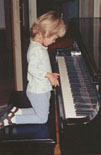
"I know how to play piano," the little boy announced earnestly. My brother and I play music for children and families and we'd just finished a show in a theater. I was in the lobby, talking with people from our audience.
"That's great," I replied encouragingly. He couldn't have been more than four years old. I pictured him sitting on telephone books stacked on the piano bench, straining to reach the keyboard. "How long have you been playing?"
"Almost a year. I got Ray Charles down pretty good, but my Mom says I need to work on the basics."
A damp memory surfaces. When my brother and I were less than two years old, we managed to climb up on top of the grand piano in my parents' living room and dumped an entire pitcher of water into its innards. The piano had belonged to my mother's father, who died long before we were born. Mothers forgive everything.
I started practicing on that piano when I was about seven years old. Pianos can endure almost anything. I never did get Ray Charles down pretty good -- or the basics for that matter. To say that I was no child prodigy would be a vast understatement. After five years of lessons I reached my pianistic high note when I barely managed to struggle through Stephen Foster's "Beautiful Dreamer" in Mrs. Mauterstock's student recital. Certainly, anyone hearing me that day could have been forgiven for laughing uncontrollably at the suggestion that someday I'd be making my living as a musician.
I quit piano lessons soon after that nightmarish recital. Just a few years later, when I fell in love with folk music and the guitar, it was different. While no one will mistake me for Segovia or Eric Clapton, I can play "Hit the Road, Jack" pretty good, and I can probably even get through "Beautiful Dreamer."
Because I play music for children, parents often ask me for advice about what is the right age to start a child on an instrument, and which instrument is best for young children. They also ask me if they should 'make' their children take lessons when they don't seem to want to. I tell them that I'm no expert on any of those topics. (I am, as I write this, the father of five year old Emily. When people ask me if she's going to take after her dad, I tell them the same thing my brother used to say when his Daniel was a baby. "We know he has the volume.") Then I tell them about my friends, the Tracy Schwarz Family Band, who had a very elegant method for introducing their children to instruments. Tracy and Eloise would lay a banjo or harmonica or guitar on the sofa and then, as they were going out the door for the evening, say to their kids, "Don't touch that!"
All their kids became fine musicians. Their youngest is accomplished on bass, keyboards, harmonica and played in concert with them for years.
Yes, occasionally I do wish I'd learned to play the piano. The longing, I admit, is most intense in airports, as I'm lugging my guitar from Concourse A to Concourse Z. But no, I don't wish my parents had made me practice more. The truth is, I didn't fall in love with piano the way I did with guitar. I don't think I'd have learned more even if I'd been forced to practice.
Now maybe, if I'd started with Ray Charles, rather than the basics...
Two weeks after the events of September 11, I finally told Emily, my seven year old daughter, about what happened that day. My wife and I had made a deliberate decision in the days following the tragedy to shield our child from the news, especially the horror filled TV pictures.
But now it was time. We knew if we did not tell her, she would hear about it from someone else. So, in the car, after school, on our way to an event where we knew it was likely to come up, I told Emily. Briefly, with a minimum of graphic details, but leaving nothing out.
It is a natural urge all parents have, to protect their children from terrifying images and frightening stories. To wait as long as possible to expose them to the sometimes cruel, unbearably sad realities of our world.
I was sixteen when my mother first told me about the Holocaust. That she was my father's second wife. That he'd lost his first wife and three children in Auschwitz, twenty years earlier. That she'd lost her only brother and her fiancÈ. I had few questions for my mother that day. The information she'd given me was too vast, too incomprehensible. She and I rarely talked about it again and more than thirty years would go by before I was finally able to talk with my father about his losses.
Now, in the car, Emily also only asked a few questions. "How far is New York? When did this happen?"
We were driving east on Stadium Boulevard and I began pointing out the many American flags and the God Bless America signs and told Emily that these were some ways that people were trying to express their support of our country and for the people who lost friends and relatives. When we got to the corner of Packard and Stadium, members of the Ann Arbor Fire Department were collecting donations. I waved one of them over to our car and put some money into the tall boot he held out. After the light changed and I drove away, I told Emily about the firefighters in New York and how the money I gave would help their families. She said, "Dad, what can I do?" I was touched and relieved. There was no fear in her question, no helplessness. We brainstormed. She too would make a God Bless America sign, she'd empty her piggy bank.
Then she said, "Dad, what else can we do?" I suggested we could be kind to everyone we meet. She enthusiastically amplified, "We could help people. Like if someone falls, we could help them up? Or if someone is lost we could show them where to go?"
"Yes," I said, "Those would be very good things to do." Over the course of the day she kept bringing up the subject and continued asking, "Dad, what else can we do?"
She didn't ask me about forgiving and I was relieved. It was two days before the Jewish holiday of Yom Kippur. In Judaism it is customary on Yom Kippur to ask for forgiveness for any harm we may have done, and to forgive those who have harmed us. But for me, right now, it felt too soon to forgive.
I thought of my parents. What did they do on Yom Kippur after they discovered what the Nazis had done to their families? Did they forgive? Later that day I called and asked them, first about the hijackers. Did we need to forgive them on Yom Kippur?
"No", my father said. "If someone comes to kill you, it is your duty to try to kill them first." Which was the most poetic justification for violence I'd ever heard, but not really a reply to my question, so I pressed on. Had he ever forgiven the Nazis on any Yom Kippur in the last fifty years?
"No," my father said again. "Forgiveness does not apply to situations like that." My mother was silent.
Besides his first wife and three children, my father also lost both his parents, his only brother and three of his eight sisters in Auschwitz. Perhaps he is right. Maybe forgiveness does not apply to situations like that. Nor to the events of September 11th.
Emily asked me why were the firemen the ones who were collecting donations? And I told her of the New York City firemen. And of all the other people who performed brave, kind and loving actions on that day and since. People who tried to save lives, did save lives, sometimes at the cost of their own.
I think again of my parents. How they and others in their families survived, while so many others were destroyed. How they were saved through the grace of God, their own personal strength and courage, and also the kindness of strangers who helped them, often at the risk of their own lives.
I will not desecrate the memories of the victims of either the Holocaust or of September 11 by comparing them. Yet I will remember, about both events, the generosity and the selfless sacrifice of strangers. I think of the words of Anne Frank. "It's a wonder I haven't abandoned all my ideals, they seem so absurd and impractical. Yet I cling to them because I still believe, in spite of everything, that people are truly good at heart."
And I think often of Emily's question. "What else can we do?"
I met Percy Danforth in 1976, after my brother Laz saw him play the bones in Donald Hall's "Bread and Roses." "You won't believe how much music he can get out of four little pieces of wood!" Laz told me. I called Percy and asked me if he would show me how to play, and with his typical generosity, he said, "Of course." I was not a quick study, but he was a patient teacher, and his enthusiasm was infectious. Finally, like thousands of others Percy taught, I started to get the hang of it.
We performed together dozens of times over the next sixteen years. I remember the way he'd kid around on stage: "Welcome to the rehearsal," He'd tell the audience, then joke about "tuning" the bones-which he actually could do by adjusting them in his hands. But most of all, I remember the dreamy look on his face as he "danced" the bones, and his surprised, joyful expression when we hit the final note together. He'd laugh, shake our hands, and say, "That came out all right." With Percy, countless times, from formal concert halls to folk festivals, coffeehouses, and schools, it came out all right-and much better than all right.
The last time we played a concert together was at a senior citizens' Christmas party a couple of years ago. We invited him to play a few tunes with us, and Percy, at age ninety, was still in great form. The seniors, many of them years younger than he, were inspired.
On June 1, Laz and I played at Hillside Terrace, the retirement community where Percy and Frances, his wife of sixty-five years, lived. As usual, I introduced him as "the man who taught me everything I know about the bones." I also told him what a thrill it still is for me when people come up and say, "You must have learned to play the bones from Percy Danforth-you look just like him when you play."
He died nine days later. Goodbye, Percy. Thank you.
For further information, please contact Sandor by e-mail at slomovits@hotmail.com. Click here to order the Danforth Bones. Click here for instructions on how to play the bones.